

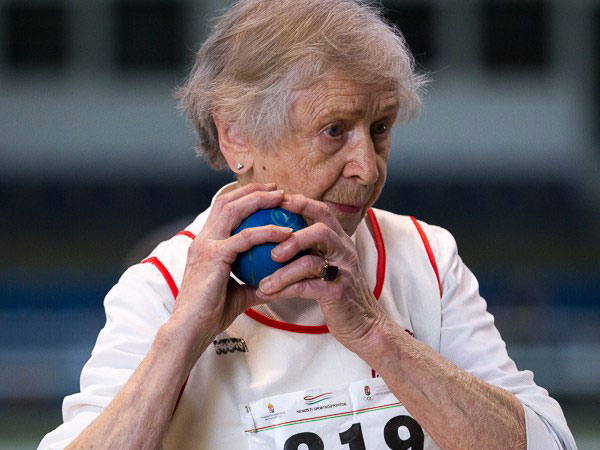
Reeling at the news that Olga Kotelko, died yesterday (June 24th). She hit a new age group, the 95-99 year old category, in March and immediately travelled to the other side of the world from her home-town of Vancouver to compete in the World Masters Indoor Championships in Budapest. She entered nine events, set world records in seven and became world champion in all nine. I’m hopeless personally when it comes to crossing time zones and I asked her how she dealt with jet lag (it’s a nine hour time difference between Vancouver and Hungary). She looked at me as though this wasn’t even a question. “No problem,” she said, bemused. She just went to bed at 10pm local time, wherever she was, and woke up 8 hours later.
One of the privileges of being a sports photographer and having a press pass at athletics events is that you can go anywhere in the stadium or on the field. Only athletes competing at any given moment are allowed such access, as well as officials of course. This means that you’re right there with the athletes as they compete and in events that take a while, such as throwing events, or jumping or pole vaulting, where competitors get several attempts and have to wait in between, you’re there alongside them. So I came to be a familiar face for Olga, who was competing in several such events in Budapest (long jump, high jump, triple jump, javelin, discus and hammer throw, to be precise) and we would often walk to different venues together and chat before, after and during. When one of the officials called out her name slightly ‘wrong’ in the javelin event, she strode over to him, gently put him right and marched back to make her best throw of the event. She came over to me and said “I’m glad he said my name wrong! That made me get mad. And when I get mad I always compete better!” Being so close to the action not only means you get the chance to take some good shots, but you’re also close up to some lovely moments that you can’t anticipate. And you get to know the competitors, especially when they get used to seeing you at all of the big meets. I’d previously met and photographed Olga in Jyvaskyla, Finland in 2012 so we knew each other a bit already. And she was so full of life and so present in the moment and so engaged with you when she was in conversation with you, that honestly now I feel as though I’ve lost a personal friend.
I know the word ‘inspiration’ is used so often it can become meaningless, but Olga truly was someone to whom it applied. 95 years young, to grab another cliché, she lived every moment (ditto but I’m struggling here and clichés are only clichés for good reason) and was full of drive, humour, determination, warmth and generosity. She laughed a lot. She really was someone who shone a beacon for us, showing us how it’s possible to joyfully anticipate old age. I hate using that term (‘old age’), but at 95 it’s probably safe to say she was old, chronologically at least. But not in any other sense.
I’ve been emailing today with my good friend Smitha Mundasad as we were together in Budapest and Smitha interviewed Olga for the BBC and made a beautiful piece about her. It was Smitha who called me this morning and told me the news. We’re both of us struggling to process what feels like a personal loss. Smitha just reminded me of the young volunteer at the championships in Budapest who was commandeered to help her with her heavy equipment (although Olga herself had already offered to give her a hand carrying some of it), a very sweet young man, a student probably, called Mate. Apparently Mate was crying when the time came for him to say goodbye to her. As Smitha says, Olga affected us all.
I had an email from Olga (no slouch with technology either) at the end of last month. I’d told her that her picture was going to be up at the Commonwealth Games in Glasgow in July and she was delighted. She wrote congratulating me and I promised to send her a picture of it when it was up. It’ll be tough seeing her there knowing she’s no longer with us. Except in spirit of course. If you’re lucky enough to meet Olga, she’s not someone you’re ever going to forget. And it’s true too that if there is such a thing as a ‘good death’, it does seem that she had one. Bruce Grierson, whose book “What makes Olga run?” documents Olga’s remarkable life, wrote that “a major blood vessel feeding Olga’s brain ruptured on Saturday night. Blood bled into brain tissue and caused severe swelling — technically it was an intracranial hemorrhage. She died this morning. Doctors say she would have lost consciousness immediately — zero suffering. It was — albeit premature and shocking — the perfect way to go out. She left nothing significant undone or undreamed.”
Dear Olga, good bye. We shall miss you very much.
You might also like

Leave a reply